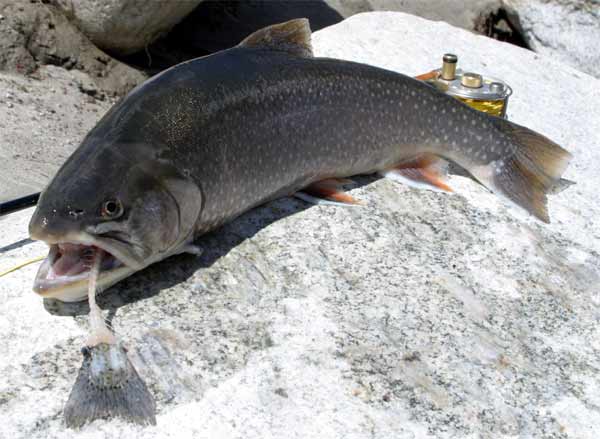
In Sweden, “röding” covers closely related char with different distributions. Large-lake char occurs in waters such as Vättern and Sommen, while Arctic char is found from Värmland northward along the mountain chain.
What does “char” mean in Sweden, and where is it found?
The Swedish Agency for Marine and Water Management distinguishes large-lake char (Salvelinus umbla), found for example in Vättern and Sommen, from Arctic char (Salvelinus alpinus), which occurs from Värmland northward along the Scandinavian mountain chain. Their biology and history differ, so Swedish char should not be treated as one uniform population.
Saibling
Source: Havs- och vattenmyndigheten: Röding (stor- och fjäll-) – arter och livsmiljöer · Last verified: 8 September 2026
Taxonomin och benämningarna kring röding är mer komplexa än en enda artpost. Guiden håller sig därför till Havs- och vattenmyndighetens aktuella uppdelning och gör inga lokala beståndspåståenden.
Different char in Sweden
The Swedish Agency for Marine and Water Management treats large-lake char and Arctic char separately. Salvelinus umbla occurs in waters including Vättern and Sommen, while Salvelinus alpinus occurs from Värmland northward along the mountain chain.
Spawning and habitat
Char generally spawns in September and October over stony shores and shallows. Habitat use and migration can vary between populations and waters.
Why the exact water matters
The word char alone does not tell you which population or ecological setting is involved. Species occurrence should not be translated into claims about abundance or fishing quality in a particular lake.
Fishing rules are local
Regulations differ between waters and areas. Check current local rules before fishing.